Artificial intelligence has rapidly evolved from an emerging technology into a practical business tool. In 2026, organisations across industries are increasingly using AI to automate repetitive tasks, improve customer experiences, analyse data, and make faster business decisions. However, simply adopting an AI tool does not guarantee business growth. Companies need the right strategy, technology, integration, and expertise to turn AI investments into measurable results. This is why AI implementation services are becoming essential for modern businesses. From generative AI and machine learning to intelligent automation and predictive analytics, professional implementation can help organisations integrate AI into their existing operations and create solutions designed around specific business goals.
Why AI Is Becoming Essential for Business Growth
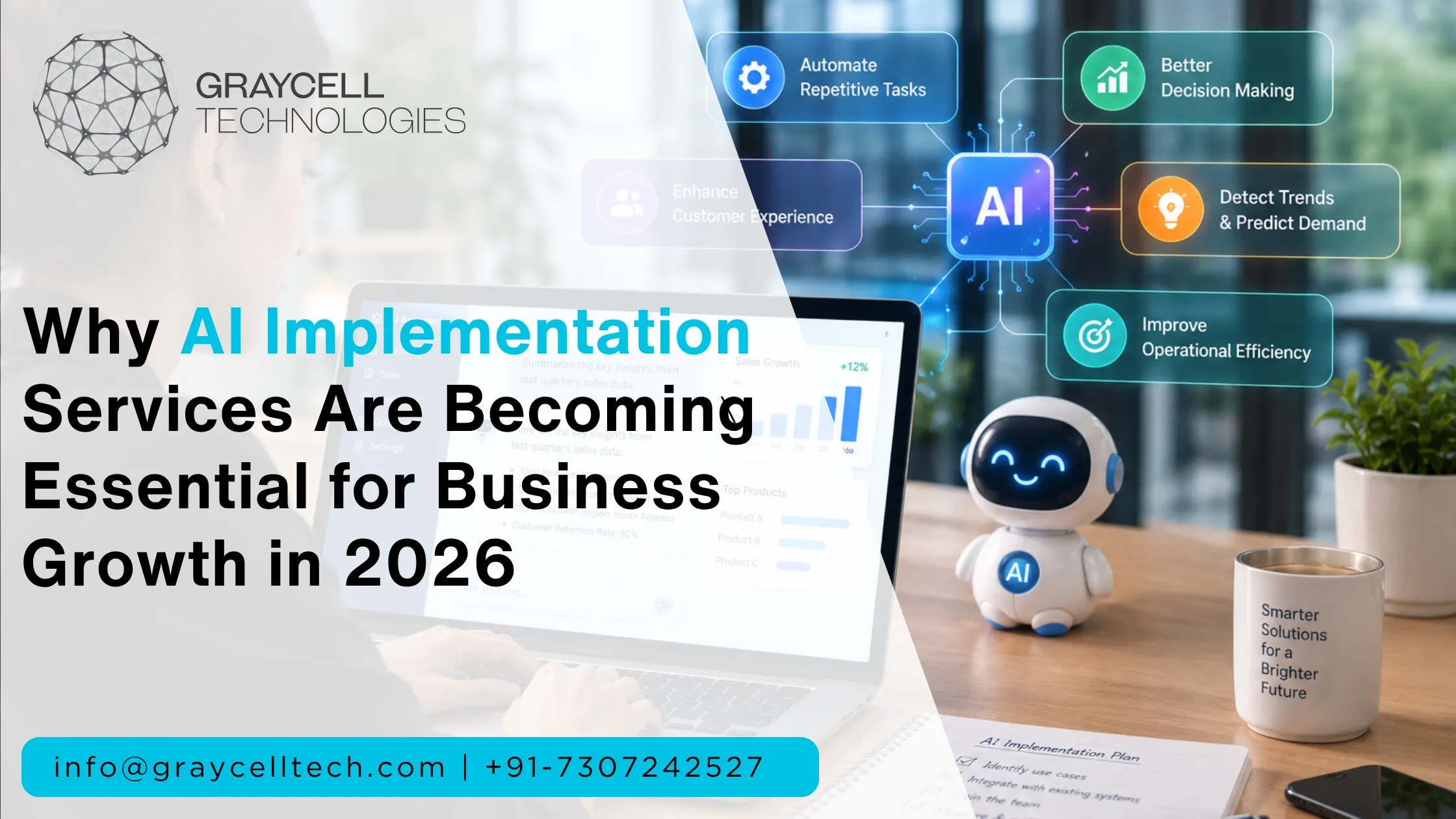
Businesses today operate in highly competitive and fast-changing markets. Customers expect quick responses, personalised experiences, and efficient services, while employees are expected to accomplish more in less time. Traditional processes can make it difficult for organisations to maintain efficiency as they grow. AI can address many of these challenges by automating repetitive work and providing intelligent support. Businesses can use AI to analyse large datasets, generate reports, answer customer queries, identify patterns, forecast demand, and assist employees with everyday tasks.
Some common applications include:
- Automating administrative and repetitive tasks
- Improving customer support
- Analysing business and customer data
- Generating content and reports
- Supporting sales and marketing teams
- Forecasting trends and demand
- Personalising customer experiences
- Improving operational efficiency
The Microsoft resource on digital transformation for small businesses similarly emphasises the role of modern digital technologies in helping businesses automate processes, improve efficiency, and remain competitive. It highlights AI-powered tools as one way organisations can reduce manual work and allow employees to focus on more strategic activities.
AI Implementation Is More Than Buying an AI Tool
One common mistake businesses make is assuming that purchasing an AI platform is the same as implementing AI. In reality, successful AI adoption requires careful planning. Businesses first need to identify the processes where AI can provide meaningful value. They then need to evaluate their existing data, technology infrastructure, security requirements, and workforce capabilities.
This is where AI implementation services can make a difference. A structured implementation process can include:
- Identifying suitable AI use cases
- Assessing existing technology and data
- Selecting appropriate AI technologies
- Developing or customising the solution
- Integrating AI with existing systems
- Testing performance and security
- Training employees
- Monitoring results
- Continuously improving the solution
The Growing Role of Generative AI Development
Generative AI has become one of the most significant developments in the AI landscape. Unlike traditional automation, generative AI can create content, summarise information, answer questions, assist employees, and interact with users through natural language.
Generative AI development can help businesses build applications such as AI-powered customer service assistants, internal knowledge platforms, document-processing systems, content-generation tools, and intelligent search solutions.
For example, an organisation could develop an internal AI assistant that allows employees to ask questions about company policies, product information, technical documentation, or internal processes. Instead of manually searching through multiple documents, employees can receive relevant information through a conversational interface.
Generative AI can therefore become part of everyday workflows rather than remaining a standalone experimental technology.
Why Businesses Need Custom AI Solutions
Every organisation has different processes, customers, data, and operational requirements. While ready-made AI tools can be useful, they may not always address a company’s specific needs. Custom AI solutions allow businesses to develop AI applications around their particular objectives. A company may, for example, require an AI system that connects its CRM, customer-support platform, inventory system, and business database.
Custom AI can be applied to areas such as:
- Customer service automation
- Sales forecasting
- Business intelligence
- Document processing
- Recommendation systems
- Predictive maintenance
- Customer segmentation
- Workflow automation
The goal should not be to implement AI simply because it is a growing trend. Instead, organisations should identify a business challenge and determine whether AI can solve it more efficiently.
How Machine Learning Consulting Supports Business Decisions
AI implementation can also involve machine learning models that analyse historical information and identify patterns that may not be immediately visible to humans. Machine learning consulting helps organisations determine where machine learning can create value and how to develop, deploy, monitor, and maintain models. Businesses can use machine learning for demand forecasting, customer segmentation, recommendation engines, fraud detection, predictive maintenance, risk analysis, and sales forecasting. However, successful machine learning requires more than creating a model. Organisations also need reliable data, appropriate infrastructure, model monitoring, security, and processes for updating models as business conditions change. Professional consulting can help businesses build a more sustainable machine learning strategy while avoiding unnecessary technology investments.
AI Consulting Services for Businesses in the Tricity
The growing technology ecosystem in Chandigarh, Mohali, and Panchkula is creating new opportunities for businesses to explore AI. Organisations in the region are increasingly looking for ways to improve productivity, customer engagement, and operational efficiency through technology. AI consulting services across Chandigarh, Mohali, and Panchkula can help businesses evaluate their current processes and identify where AI can deliver the greatest business impact.
A consulting-led approach can help organisations prioritise AI initiatives based on:
- Business value
- Implementation complexity
- Data availability
- Cost
- Security requirements
- Scalability
- Employee adoption
For organisations specifically exploring generative AI services in Chandigarh, consulting can also help determine whether they need an existing AI platform, a customised application, or a fully developed generative AI system.
Microsoft Case Study: Digital Transformation for Small Businesses
According to Microsoft, digital transformation can help small and medium-sized businesses streamline operations, automate processes, improve customer relationships, and create a foundation for future growth. Rather than adopting technology simply for the sake of modernisation, businesses should connect technology investments to specific business objectives. The resource highlights the use of AI-powered tools for automating activities such as data entry, scheduling, and reporting. It also discusses how CRM and cloud technologies can help businesses improve customer engagement and scale their operations. Microsoft provides examples of businesses using digital technologies to solve practical challenges. Bartek, for instance, adopted Dynamics 365 Business Central and Power Apps to automate processes and connect business operations as the company grew. Northrop & Johnson used Dynamics 365 Sales to streamline operations and support more personalised customer engagement. The technology creates the most value when it is connected to a clear business need. AI implementation should therefore focus on measurable improvements rather than simply adding new technology to an organisation’s existing infrastructure.
Conclusion
AI is becoming an increasingly important driver of business growth in 2026. However, successful AI adoption requires more than simply purchasing software or experimenting with popular tools. Businesses need a structured approach that connects AI technology with their operational needs and long-term business objectives. AI implementation services can help organisations move from experimentation to practical adoption by bringing together strategy, development, system integration, data management, security, and continuous optimisation. Custom AI solutions and machine learning consulting can further help businesses address specific challenges while building scalable and future-ready AI capabilities. By partnering with an experienced technology provider such as GrayCell Technologies, businesses can identify practical AI opportunities, implement the right solutions, and build AI capabilities that support sustainable growth and long-term competitiveness.